
Order of Glory, 3rd class
An award was established by Decree of the Praesidium of the Supreme Soviet on November 8, 1943. While most of the Order of Glory awards were for combat valour in the Second World War, there are documented instances of awards of the order’s lowest, third class, for post-war Soviet military operations. The total amount of awards was under one million. Subsequent distinct acts of valour could result in the soldier being recommended for the order’s two remaining higher classes. In Soviet society, “Full Cavalier of the Order of Glory” was accorded the same rights and privileges as those granted to personnel who had received the Hero of the Soviet Union title. The number of Full Cavaliers was 2656.
Requirements
Without mentioning a vast list of requirements, I will give several examples of valourous acts that could bring an Order of Glory to the recipient.
For the ground troops, for example:
- personally capturing an enemy officer;
- participation in a night raid and destroying enemy military stores and property;
- for displayed marksmanship in the killing of from 10 to 50 enemy soldiers and officers using personal weapons
For the aviation:
- for bold actions in an air battle resulting in the destruction of one or two enemy aircraft;
- a successful air attack that resulted in between 2 and 5 destroyed enemy tanks, or from 3 to 6 locomotives, or the destruction of an entire train, or the destruction of at least 2 enemy aircraft on their airfield;
- the destruction of a railway station or marshalling yard, ammunition dump, fuel stores, port facilities, naval transports, an entire train, an important plant or factory
My order
That is my first Soviet order. I was able to select what I could purchase from several researched orders. You can barely surprise anyone with the number of your kills at war, but awards for life-saving give a strong feeling of humanism, even if that was someone’s assigned mission.
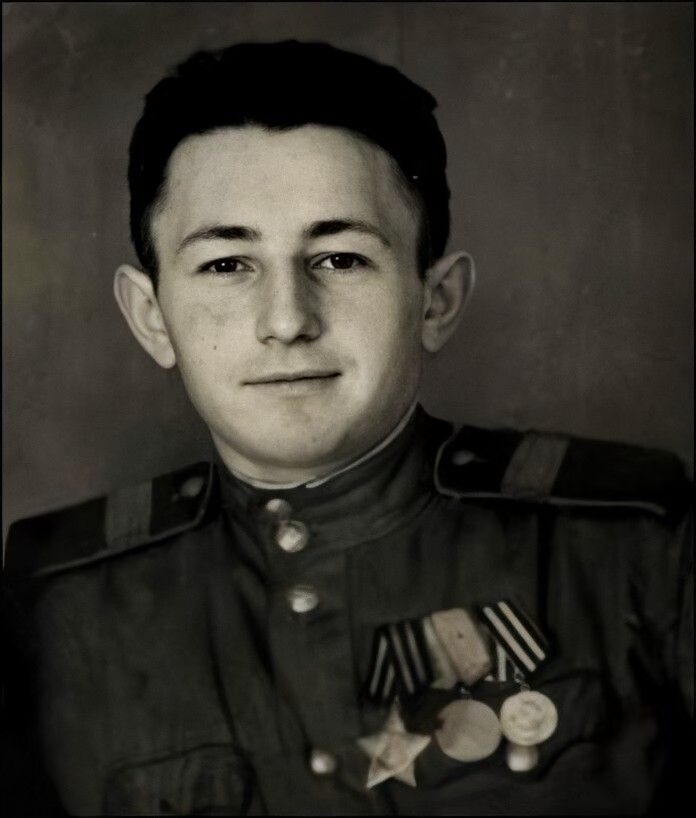
Senior Sergeant,
Terekhov Anatoly Nikolaevich (Терехов Анатолий Николаевич)
In the picture, you can see his awards (from right to left): the Victory over Germany, the Medal “For Courage”, and the Order of Glory, which I now possess.
A sad story of many Soviet awards is hidden in the 1990s, when family members sold them for nothing to get any money, which might not have been spent on the best purposes. According to parts of the story I found on the internet, his living descendants kept his legend alive, which matches what was written in the military documentation. So, I post his combined story here.
He was born on the 7th of September 1924 and received an education as a ship mechanic. Drafted by the Kineshma District Military Commissariat of the Gorky Region.
Took the military oath on December 10, 1942. Served in the 1410th Anti-Aircraft Artillery Company, 1st Baltic Front, 39th Anti-Aircraft Artillery Division.
From December 10, 1942, to July 5, 1943, he was the commander of the 13th battery’s long-range unit with the rank of sergeant.
From July 5, 1943, to November 1, 1943, he was in the reserves due to injury, serving as a medical instructor with the rank of senior sergeant. Underwent treatment.
From November 1, 1943, to March 1, 1944, participated in battles near Vitebsk.
From June 1, 1943, to May 1, 1945, he served in the 10th Anti-Aircraft Artillery Regiment.
From June 22, 1944, to September 10, 1944, he took part in breaking through German defences during the liberation of Western Belarus and the Baltic states. He was awarded the Medal “For Courage” on August 3, 1944.
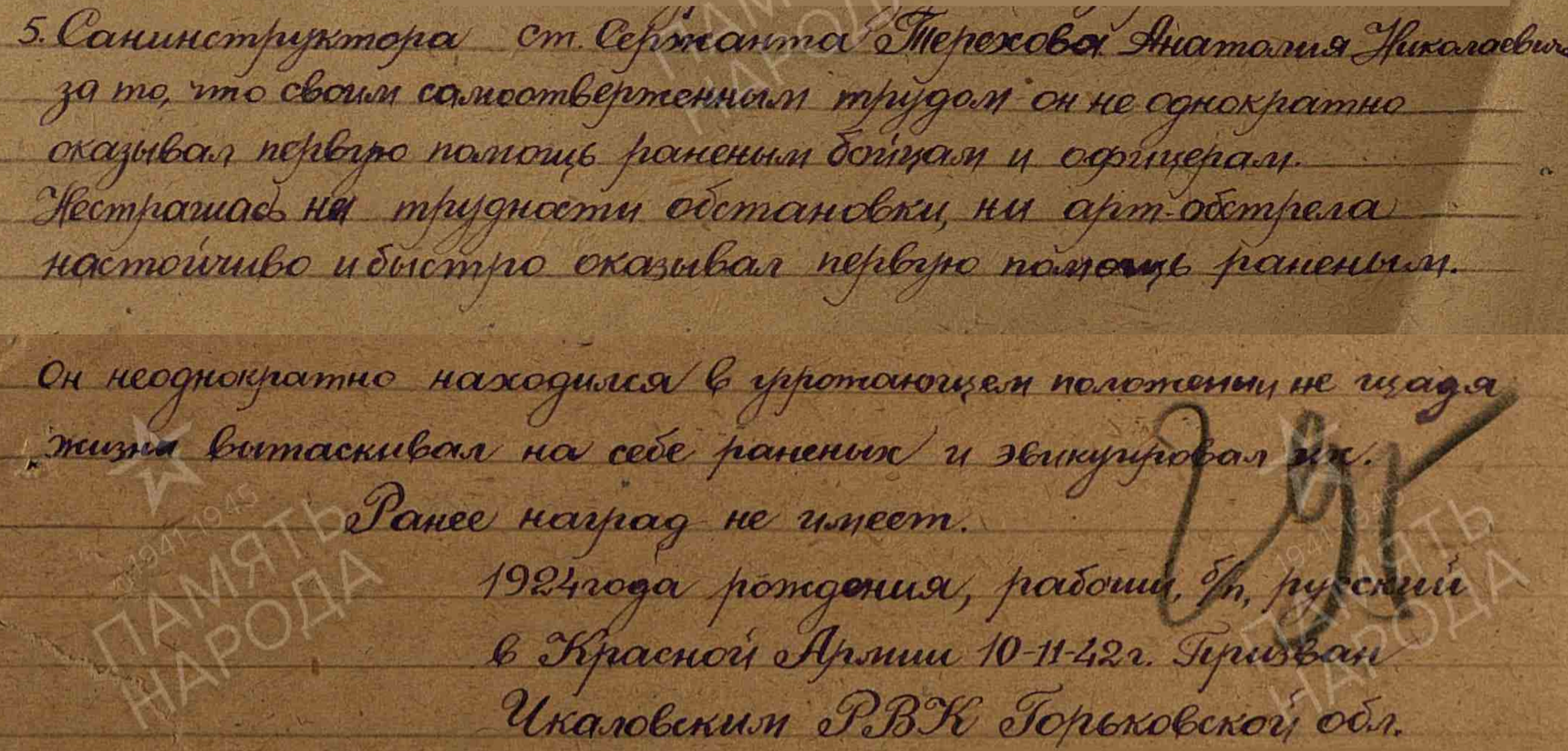
“Medical instructor Senior Sergeant Terekhov Anatoly Nikolaevich is awarded for his selfless work, repeatedly providing first aid to wounded soldiers and officers. Fearless in the face of challenging conditions and artillery fire, he persistently and swiftly rendered medical assistance. He repeatedly risked his life to carry wounded soldiers to safety.
Previously unawarded. Born in 1924, a worker, a non-party member, Russian. In the Red Army since November 10, 1942. Drafted by the Chkalov District Military Commissariat of the Gorky Region.”
On August 20, 1944, he was transferred to an anti-aircraft machine gun company with the rank of senior sergeant.
Received official gratitude by order of the Supreme Commander-in-Chief, Marshal of the Soviet Union, on September 9, 1944.
From October 5, 1944, to May 8, 1945, he participated in the breakthrough of German defences in the Šiauliai region. He was awarded the Order of Glory, 3rd Class.
Received a commendation from his company commander during ammunition unloading on November 23, 1944.
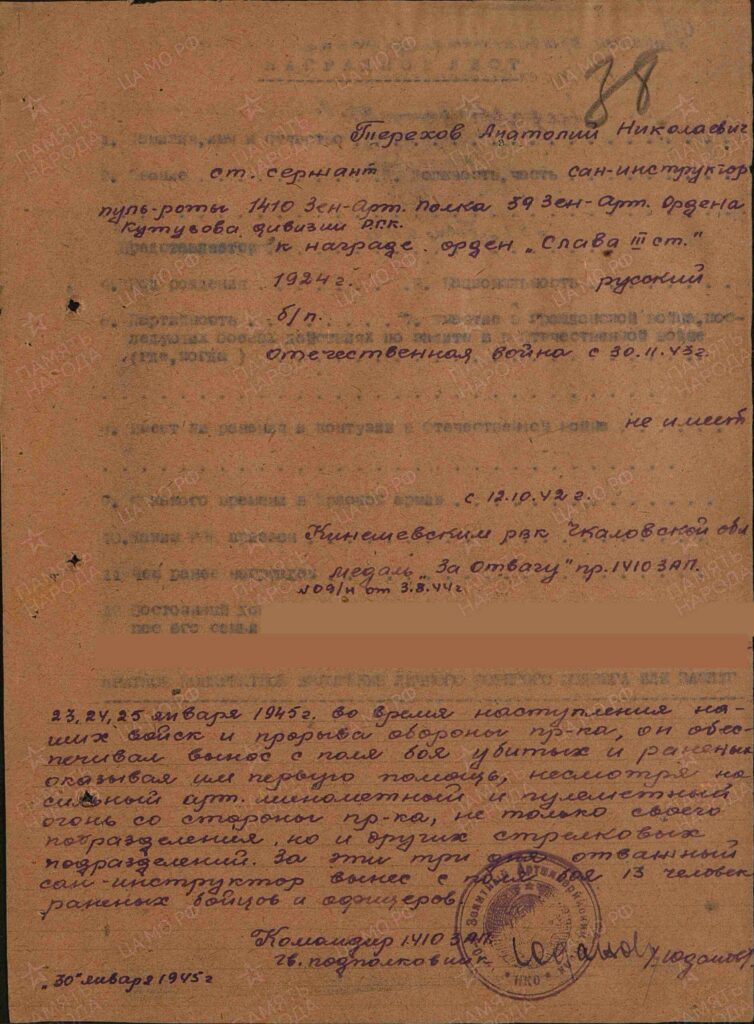
“On January 23, 24, and 25, 1945, during our troops’ offensive and the breakthrough of enemy lines, he ensured the evacuation of the dead and wounded from the battlefield, providing first aid under intense artillery, mortar, and machine gun fire. He assisted not only his own unit but also other rifle units. Over these three days, this brave medical instructor carried 13 wounded soldiers and officers off the battlefield.
Commander of the 1410th Anti-Aircraft Artillery Regiment, Guard Lieutenant Colonel Yudanov, January 30, 1945.”
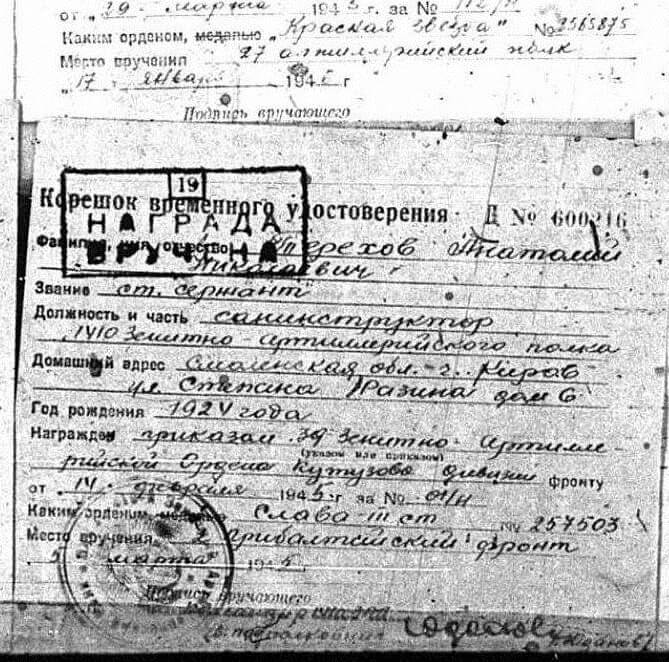
“Terekhov Anatoly Nikolaevich, senior sergeant and medical instructor of the 1410th Anti-Aircraft Artillery Regiment, resides in the Smolensk region, specifically in the city of Kirov, at Stepan Razin Street, house 6. Year of birth: 1924. Awarded by order of the 39th Anti-Aircraft Artillery Order of Kutuzov Division, dated February 14, 1945, number 01/n, the Order of Glory, 3rd degree, number 257503. Place of award, 2nd Baltic Front, March 4, 1945.”
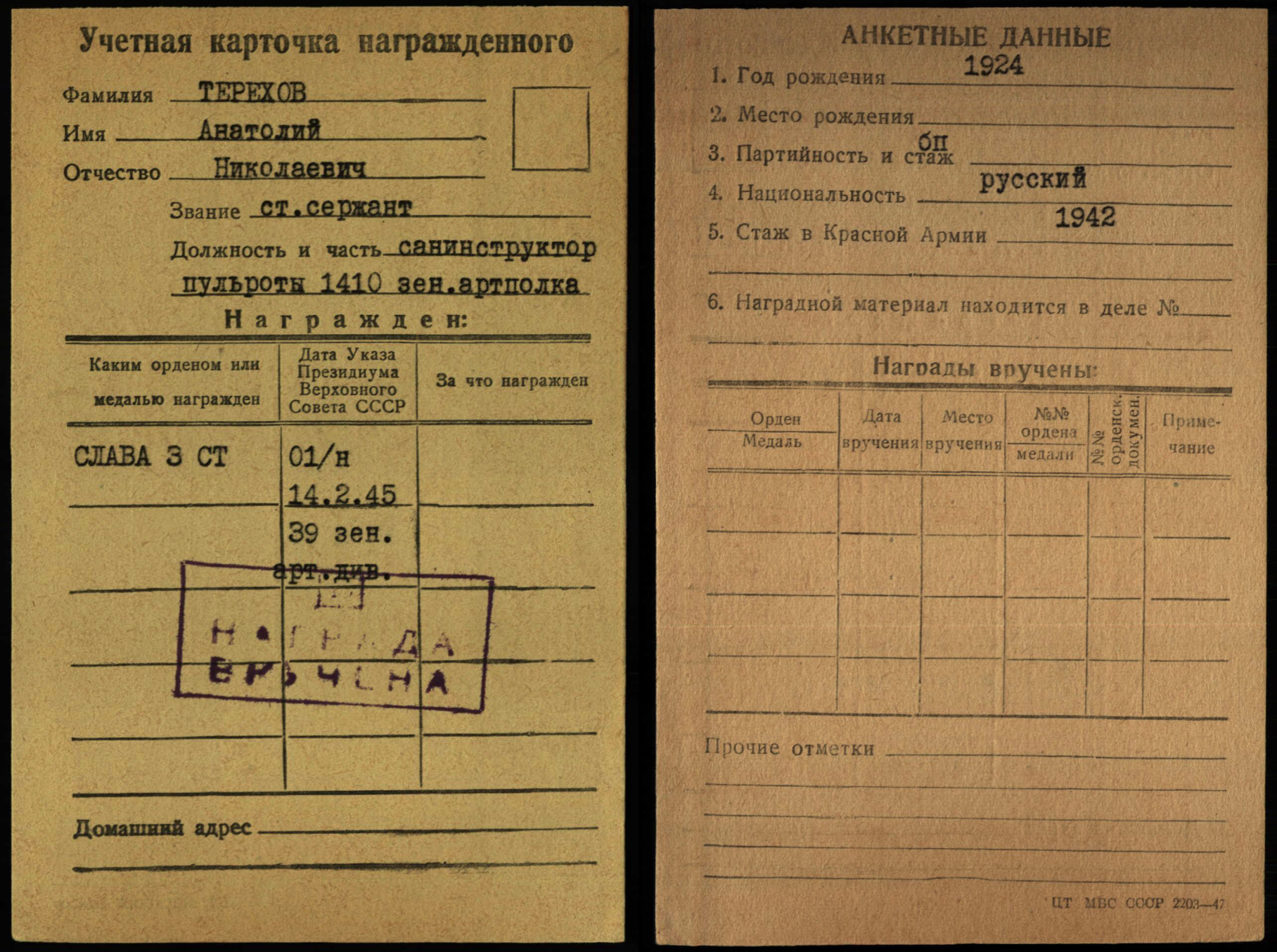
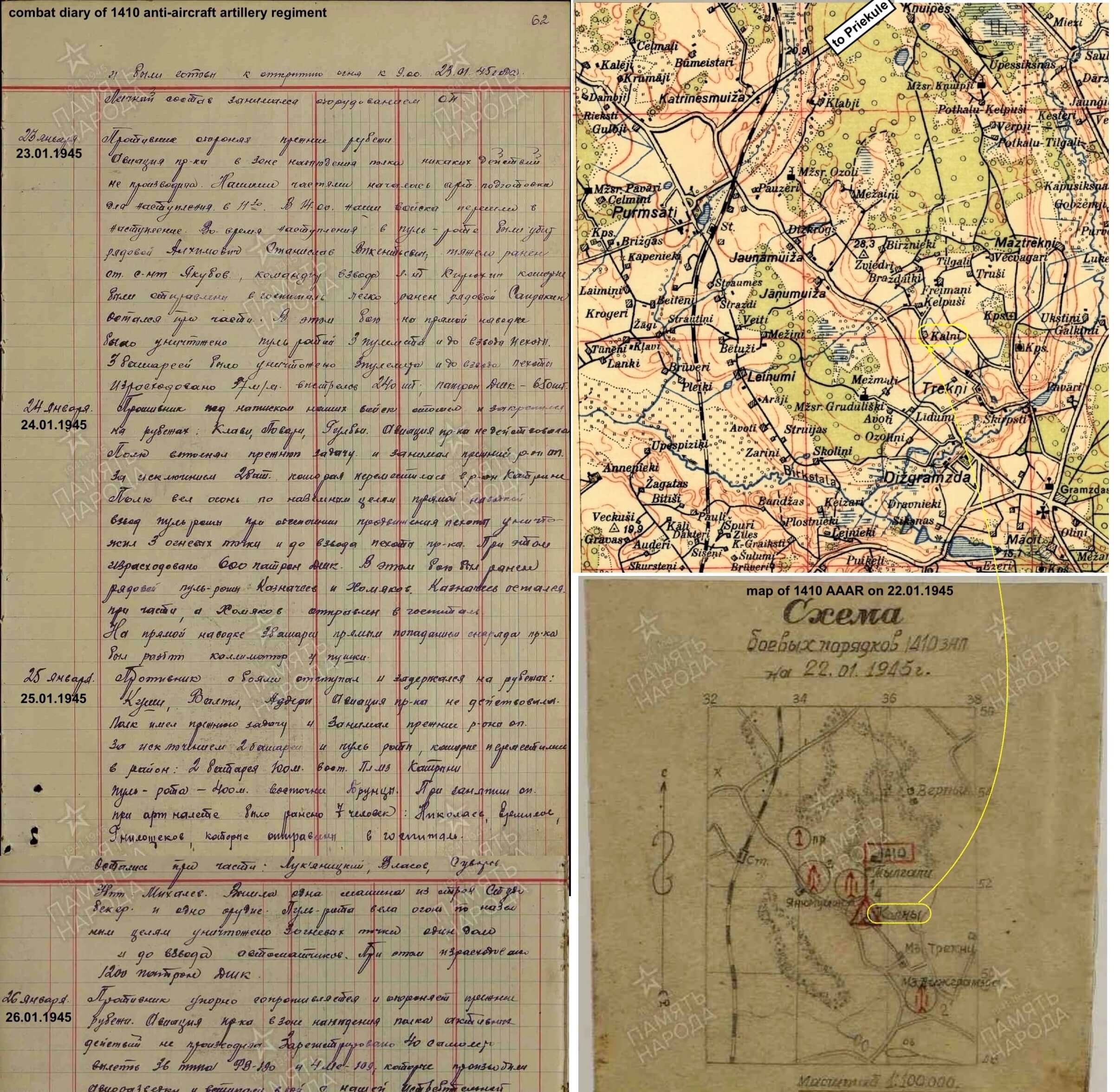
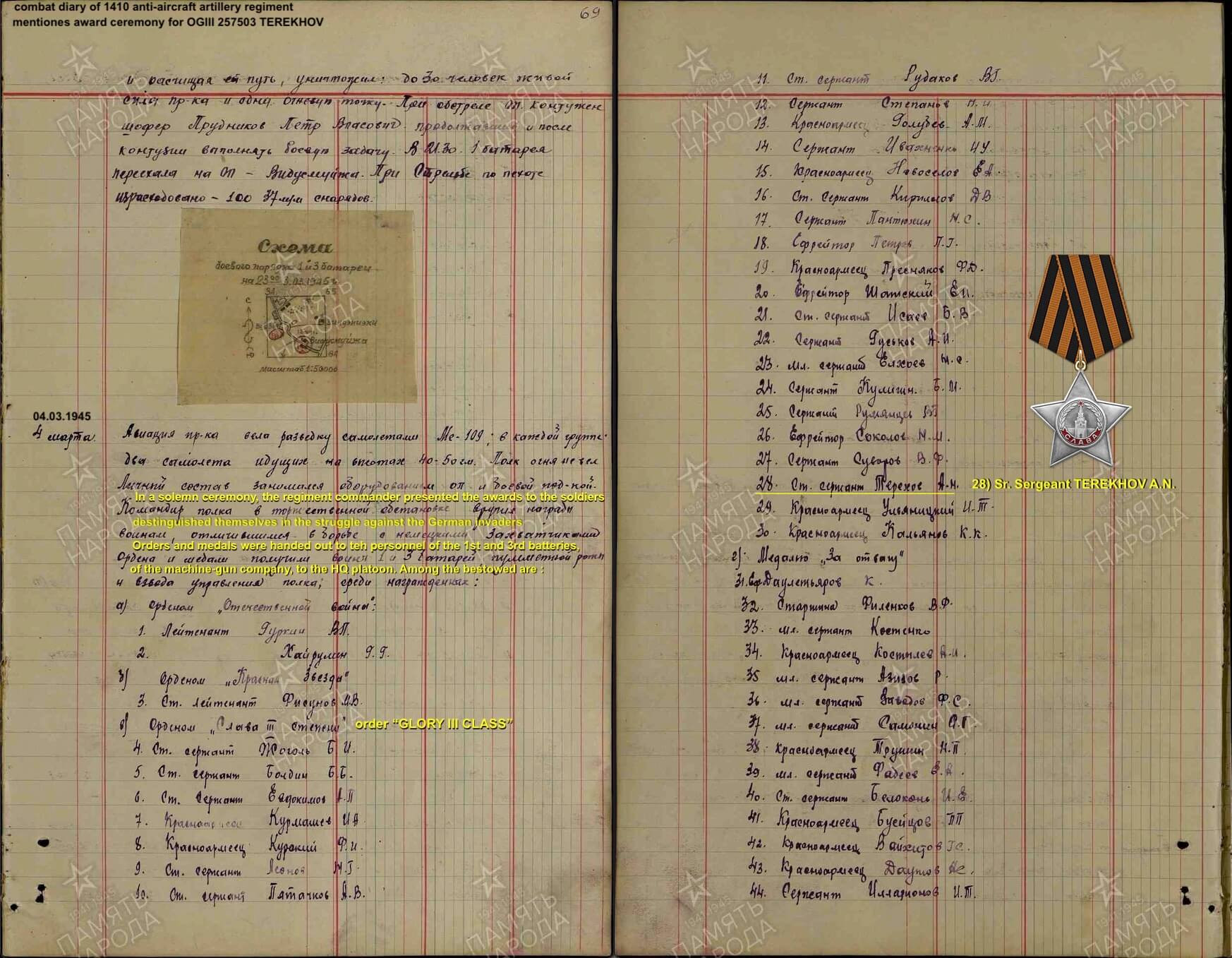
Terekhov was awarded the Medal “For the Victory over Germany in the Great Patriotic War of 1941–1945.” Terekhov was demobilised on March 21, 1947. After that, he moved to Kaluga, Russia, where he probably died. Open sources contain little information about the post-war fate of Anatoly Nikolaevich Terekhov.
Part of this history was published online in 2014 by his great-grandson, Yegor Mishakov, a 6th-grade student at Secondary School No. 2 of the city of Kirov (MKOY “SOSH No. 2”).